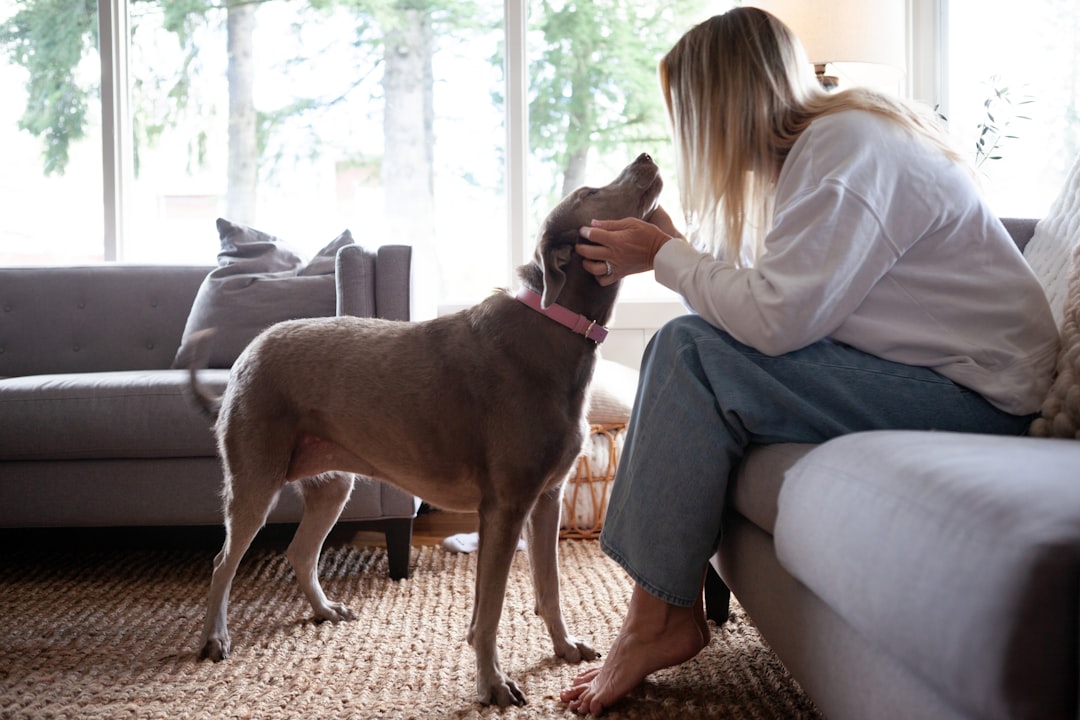
Emotional Support Dog Training at Home (2026 Guide)
Most people who ask me about emotional support dog training are already doing more of it than they realize — they just don't know how to make it intentional.
Over the past 15 years, I've worked with hundreds of dog owners navigating the emotional support animal process, and the same misconception keeps surfacing: that an emotional support dog (ESD) is simply a pet with a letter attached. That assumption leads to real problems. A dog who jumps on guests, panics in elevators, or barks through therapy sessions isn't just undertrained — he's actively undermining the emotional support he's supposed to provide.
The good news? You don't need a professional trainer to build a solid foundation at home. What you do need is a clear roadmap.
In this guide, I'll walk you through everything from honestly assessing whether your dog is the right fit, to teaching the five core obedience skills that every ESD genuinely needs, to the quieter, more specific behaviors — like deep pressure therapy and grounding interruptions — that actually make a difference during hard moments. We'll also cover socialization, troubleshooting common setbacks, and the practical paperwork side of things, including how to keep your ESD documentation valid under 2026's current housing guidelines.
Whether you have a newly adopted rescue or a dog you've lived with for years, this guide meets you where you are. The training principles are the same either way: consistent, kind, and grounded in what the science actually tells us about how dogs learn.
Let's start with the piece most people get wrong from the very beginning — what emotional support dog training actually means.
What Emotional Support Dog Training Actually Means (And What It Doesn't)

Something I hear almost every week from new clients: "I got my ESA letter, so we're all set, right?" The letter is just the beginning, not the finish line.
There's a lot of confusion around emotional support dogs, and honestly, I get it. The terminology is murky, the legal landscape keeps shifting, and well-meaning but inaccurate information spreads fast online. So before we talk about how to train your emotional support dog, let's get clear on what you're actually training for.
ESDs vs. Service Dogs vs. Therapy Dogs: A Clear Breakdown
These three categories get collapsed into one thing constantly, and they are genuinely different:
- Emotional Support Dogs (ESDs) provide comfort and companionship to a person with a diagnosed mental or emotional disability. Their presence itself is the support. They do not need to perform specific trained tasks to qualify legally.
- Psychiatric Service Dogs (PSDs) are trained to perform specific tasks that mitigate a handler's disability — things like interrupting self-harm behaviors, waking someone from a nightmare, or retrieving medication. Under the ADA, these dogs have full public access rights.
- Therapy Dogs are trained and certified to provide comfort to other people in hospitals, schools, and care facilities. They're not covered by the same legal protections as either of the above.
The practical difference in 2026 matters enormously. Under current federal law, ESDs have no guaranteed public access rights. They are not permitted in restaurants, stores, or public transit simply because of their ESD status. Their primary legal protection is housing-based — under the Fair Housing Act, qualified individuals can request reasonable accommodation to keep an ESD in a no-pets building or avoid pet fees.
This means the home and household environment is where your training focus belongs. Your dog doesn't need to hold a perfect heel through a grocery store. They need to be a stable, calming presence in your living space.
Why 'Untrained' ESDs Often Make Anxiety Worse, Not Better
Here's the hard truth I've seen play out dozens of times: a dog with behavioral problems doesn't reduce your stress — it multiplies it.
I worked with a client in her late twenties who had severe generalized anxiety. She adopted a two-year-old rescue Lab mix, got her ESA documentation in order, and expected things to improve. Instead, she was spending three hours a day managing destructive behavior, losing sleep over midnight barking, and feeling guilty every time she left the apartment. She described feeling more anxious than before she got the dog.
The dog wasn't bad. He was undertrained and overstimulated. Within eight weeks of consistent work on the fundamentals, he became exactly what she needed — a calm, grounding presence who settled quietly next to her during her worst moments.
An ESA letter certifies your need for emotional support — full stop. It says nothing about your dog's temperament, training history, or behavior. A letter doesn't teach a dog to settle when you're overwhelmed, stop jumping on guests who trigger your social anxiety, or stay calm during a thunderstorm when you're already at your limit.
What genuinely good ESD training produces is deceptively simple: a dog who is predictable, manageable, and calming rather than a source of additional chaos. Specifically, that looks like:
- Settling quietly on a

or designated spot when you need stillness
– Responding reliably to basic cues so you’re not constantly chasing or correcting them
– Tolerating normal household stressors — visitors, noises, routine changes — without reactive outbursts
– Being comfortable enough in their environment that *they’re* not anxious, because an anxious dog cannot effectively calm an anxious person
That last point deserves emphasis. Dogs read our emotional states with remarkable accuracy, but that relationship runs both ways. A chronically stressed or under-stimulated dog will amplify the emotional temperature of your home, not lower it.
The goal of everything in this article is to help you build a dog who genuinely earns that "emotional support" label — not through paperwork, but through who they are to live with every single day.
Assessing Your Dog Before You Start Training
Before you invest weeks of effort into emotional support training, you need an honest picture of who your dog actually is right now. I've seen well-meaning owners skip this step and build an entire training plan on a shaky foundation — only to hit a wall at week three when the dog's underlying anxiety or reactivity becomes impossible to ignore. Fifteen minutes of honest assessment saves months of frustration.
The Traits That Actually Matter for Emotional Support Work
Not every dog is temperamentally suited for this role, and that's okay. The traits I look for when evaluating an ESD candidate are:
- Biddability — Does your dog want to engage with you? A dog that checks in with you frequently, makes eye contact voluntarily, and responds to your emotional state is already halfway there.
- Low reactivity — Does the dog recover quickly from unexpected sounds, strangers, or sudden movements? Recovery time matters more than initial reaction.
- Comfort-seeking behavior — Does your dog naturally move toward you when you're distressed? This instinct is the bedrock of emotional support work. You can train many things, but genuine comfort-seeking is largely hardwired.
- Emotional stability at rest — Watch your dog for five minutes in a calm environment. Can they settle without pacing, whining, or scanning the room obsessively?
The dogs who excel as ESDs are often what trainers call "velcro dogs" — individuals who stay close, read their person's mood, and actively seek physical contact. Certain breeds show this tendency more often: Golden Retrievers, Labrador Retrievers, and Cavalier King Charles Spaniels come up again and again for good reason. That said, individual personality outweighs breed every single time. I've worked with a Chihuahua mix who was a more natural emotional support animal than any Labrador I've met, and I've assessed Golden Retrievers who were far too independent and stimulus-driven for the role.
Age and Starting Point Change Everything
A 4-month-old puppy and a 2-year-old dog with zero obedience foundation are not the same training project. The puppy has a blank slate, enormous neuroplasticity, and no entrenched habits — but also no impulse control and a short attention span. The 2-year-old may have months of self-rewarding behaviors baked in that need to be gently unwound before you can build new ones.
I had a client in 2026 who adopted a 3-year-old Beagle and assumed his baseline was "basically zero." What we actually discovered in assessment was that he had a solid sit and down — learned informally — but zero leash manners and significant food reactivity. Knowing that upfront meant we didn't waste time on skills he already had and went straight to the gaps that mattered most.
A Simple 10-Minute Home Temperament Check You Can Do Today
Run through this informal evaluation in a quiet space at home:
- Sound sensitivity test — Drop a set of keys on a hard floor. Does your dog startle and recover within 10–15 seconds, or remain alert and scanning for several minutes?
- Handling tolerance — Gently touch your dog's ears, paws, and muzzle. Note whether they lean in, tolerate passively, or try to move away.
- Stranger greeting — Have someone your dog doesn't know well enter the room calmly. Does your dog approach, ignore, or retreat?
- Stress baseline check — While sitting quietly, observe for stress signals: yawning out of context, lip licking, whale eye (showing the whites of the eyes), excessive panting, or inability to settle. These are your dog's current emotional vocabulary, and you need to know it before adding new training demands. A

offered during this session can help reveal whether your dog can decompress with a simple calming activity.
Red Flags That Suggest Professional Help Before Home Training
Some dogs genuinely need a veterinary behaviorist or certified applied animal behaviorist before home training begins. Don't push forward if you observe:
- Growling, snapping, or biting in response to handling, startling, or frustration
- Persistent fear responses — cowering, trembling, or hiding that doesn't resolve with gentle reassurance within a few minutes
- Separation distress that causes destructive behavior or self-harm
- Any history of aggression toward people or other animals
These aren't disqualifiers forever, but they are signals that professional assessment comes first. Asking a dog with unaddressed fear or aggression to take on the emotional demands of support work is genuinely unfair to that animal — and ultimately counterproductive for you.
The 5 Core Obedience Skills Every Emotional Support Dog Needs
Before we get into the emotionally specific behaviors — the nudging, the pressure application, the grounding techniques — your dog needs a rock-solid foundation of basic obedience. The owners who skip this step always hit the same wall around month three: their dog is great at home but falls apart the moment real life shows up.
Here are the five skills I consider non-negotiable.
1. Sit and Down on a Single Verbal Cue
Not two cues, not a hand signal plus a verbal, not "sit… SIT… sit, come on." One word, one response.
The standard I use with my clients is 10-environment reliability before considering a skill "trained." That means your dog sits reliably in the kitchen, the backyard, the vet waiting room, a friend's house, a parking lot, and six other places with varying levels of distraction. If your dog sits beautifully in your living room and stares at you blankly at the park, the skill isn't trained — it's just practiced in one room.
2. Loose-Leash Walking
A dog that pulls, lunges, or wraps around your legs on a walk is actively working against your emotional support. I've seen clients arrive at therapy appointments sweating and dysregulated because their dog dragged them through a parking lot. That's the opposite of support.
The goal isn't a formal heel position — it's simply a dog that moves with you, not against you. A

can help you manage pulling while you’re teaching, but it’s not a substitute for the training itself. Focus on rewarding the moment your dog chooses to walk at your side rather than correcting the pulling.
3. Solid Stay (The 3D Framework)
Stay is built across three dimensions: duration, distance, and distraction — in that exact order. Most people try to add all three at once and end up with a dog that breaks every time.
My benchmark for ESD work is a 3-minute down-stay in a room with moderate activity — the TV on, someone moving around, a knock at the door. Get there gradually. Start with 10 seconds, then 30, then a minute. Add distance only after duration is solid. Add distraction last.
4. Recall
Coming when called isn't just a safety skill — it's a responsiveness signal. A dog that checks in with you, that turns toward you when you call their name, is a dog who is attuned to your emotional state. That attunement is the whole point. Keep recall training genuinely rewarding. I always recommend keeping a

on you during training so the reward is immediate and consistent.
5. Settle on a Mat or Designated Spot
This is the skill I wish every ESD owner prioritized from day one, and the one most people skip entirely. "Settle" means your dog goes to a specific spot — a mat, a bed, a corner — and relaxes there on cue, even when things are happening around them.
For ESD work, this is practically priceless. Your dog needs to be able to settle beside you during a difficult phone call, in a waiting room, or while you're managing a hard moment. This skill is what separates a dog that supports you from a dog that adds to your stress.
How to Use Marker Training (Clicker or Verbal) for Faster Results
Marker training — using a precise signal like a clicker or the word "yes" to mark the exact moment your dog does something right — dramatically speeds up skill acquisition. The marker bridges the gap between the behavior and the reward, which is especially important when you're working on duration or distance behaviors where you can't deliver a treat instantly.
Pick one marker and use it consistently. "Yes" works just as well as a clicker for most dogs.
Building a Training Schedule That Fits Real Life in 2026
The structure I recommend: three 5-minute sessions daily, rather than one long session. This isn't just a convenience tip — it's backed by how dogs actually learn. Shorter, frequent sessions keep engagement high and prevent the frustration that comes with fatigue.
Morning, midday, and evening works well for most people. Anchoring sessions to existing transitions — after coffee, before dinner, before bed — keeps them consistent without requiring extra willpower. Consistency beats intensity every single time.
Teaching Emotional Support-Specific Behaviors at Home
Here's something I tell every client who comes to me after getting their ESD letter: the paperwork is the easy part. What actually makes your dog useful during a mental health crisis is deliberate, patient training. The handler-dog teams who struggle aren't struggling because their dog doesn't love them — their dog loves them deeply. They're struggling because love isn't a trained behavior, and consistency during a panic attack requires exactly that.
Your dog's natural empathy is the raw material. Training is what shapes it into something reliable.
Capturing Natural Comfort Behaviors vs. Actively Shaping New Ones
Before you teach anything new, spend three to five days just watching. Carry a

and some

and notice what your dog already does when you’re upset or sitting quietly. Does she rest her chin on your knee? Does he nose your hand when you’ve been still for too long?
These are capturable behaviors — moments you can mark with a click and reward to begin building a cue around. Capturing is faster and more intuitive than shaping from scratch because you're reinforcing something the dog is already motivated to do.
Other behaviors — like a sustained lap pressure or a specific nightmare-response — need to be actively shaped, meaning you build them step by step from simpler movements. Both approaches are valid; knowing which one you're using keeps training sessions focused.
How to Shape Lap Pressure Without Creating Jumping Problems
Pressure therapy behavior (sometimes called DPT-adjacent, since true Psychiatric Service Dog DPT requires a different legal standard) involves your dog resting meaningful weight on your lap or chest on cue. Here's how to teach it without accidentally training a jumping habit:
- Start on the floor. Sit cross-legged and lure your dog to place both front paws in your lap. Click and treat the moment contact happens. Do this 10–15 times over two days.
- Build duration. Once paws land reliably, delay the click by 2 seconds, then 5, then 10. You're shaping settling, not just touching.
- Add the cue. When the dog is consistently holding for 8–10 seconds, introduce a verbal cue like "settle here" right before they move into position.
- Progress to a couch or chair. Now the dog is approaching from a sitting position beside you, not jumping up from the floor — which eliminates most jumping-problem contamination.
- Generalize slowly. Practice lying on your back with the dog resting weight on your chest. This takes most dogs two additional weeks to feel comfortable with.
Step-by-Step: Training the 'Check-In' Nudge in 7 Days
The grounding nudge — a deliberate nose-to-hand or nose-to-leg touch — is one of the most practical behaviors I train, because it interrupts dissociation and panic cycles without requiring your dog to judge the severity of your distress. You don't need them to "sense" anything. You need them to respond to a cue.
Days 1–2: Hold a treat in your closed fist. Let your dog nose your hand to investigate. The moment their nose touches your hand, click and open your fist. Repeat 20 times per session.
Days 3–4: Open your empty hand, palm facing them. Wait. When their nose touches your palm, click and treat from your other hand. Add the cue: "touch."
Days 5–6: Generalize to your leg, your knee, your arm. Same cue, same reward rate.
Day 7: Begin pairing the cue with a simulated distress signal — pause your movement, breathe shallowly, go still. Cue "touch." Over the next few weeks, fade the verbal cue by waiting one beat longer each session, allowing your dog to respond to your body language before you ask.
One client of mine — a veteran managing PTSD — told me that her dog's nudge was the first thing that reliably pulled her back during dissociative episodes. It took six weeks to get there. It was worth every repetition.
Waking from Nightmares
This one requires the most patience. You're conditioning your dog to respond to movement and vocalizations during sleep — sounds, restlessness, changes in breathing. Start by rewarding any spontaneous approach your dog makes when you're lying down and moving. Then, over 4–6 weeks, begin lightly simulating sleep disturbance sounds during waking training sessions. Never startle your dog awake; that teaches avoidance, not approach.
The goal is a dog who gently paws or nudges — not barks or jumps — which again comes back to having a reliable "touch" foundation already in place.
Socialization and Desensitization for a Well-Adjusted ESD
One of the biggest mistakes I see owners make is treating socialization like a checkbox — something you do during puppyhood and then consider complete. I worked with a four-year-old Labrador mix named Biscuit whose owner had done everything right in those early months. Puppy classes, park visits, meet-and-greets. By 16 weeks, Biscuit seemed bombproof. Then his owner's anxiety disorder worsened significantly, and she started relying on him as an ESD — only to discover he'd become noise-reactive, spooked by the doorbell, and visibly distressed when she cried. All that early work had faded without maintenance.
Socialization is a living practice, not a developmental milestone.
The Difference Between Socialization and Flooding (And Why It Matters)
This distinction is non-negotiable, and getting it wrong can permanently damage your dog's confidence.
Socialization means introducing your dog to new stimuli at an intensity level they can handle — where they remain calm, curious, or only mildly alert. Flooding is forcing exposure to full-intensity stimuli and waiting for the dog to "get over it." Flooding might appear to produce results in the short term, but it almost always creates deeper anxiety responses over time, especially in sensitive dogs who are already temperamentally suited to emotional support work.
The working principle behind proper desensitization is sub-threshold exposure — staying just below the level of intensity that triggers a stress response. Paired with high-value rewards (I keep a
Similar Posts
Train Your Dog to Stay Calm When the Doorbell Rings (2026)
The doorbell rings. In the next 4 seconds, your dog transforms from a calm companion into a 60-pound chaos machine — barking, spinning, launching themselves at the door while your visitor stands awkwardly on the porch wondering if they should leave. I've worked with hundreds of reactive dogs over my career, and doorbell reactivity is…
Corgi Herding Behavior: Management Tips for Owners
Introduction If your corgi constantly nips at your heels when you're walking around the house, circles your children like they're wayward sheep, or becomes absolutely fixated on chasing the vacuum cleaner, joggers, or bicycles, you might think you've got a behavior problem on your hands. Here's the truth: you don't have a misbehaving dog—you have…
Dogs Suddenly Not Getting Along? 7 Fixes That Work (2026)
Introduction You walk through your front door after a routine trip to the grocery store, and instead of the usual enthusiastic greeting, you're met with a scene that makes your stomach drop: your two dogs who've been best friends for years are standing rigid, hackles raised, growling at each other. Or maybe it happened right…
Counter Conditioning Fearful Dogs: Complete 2026 Guide
Most people give up on their fearful dogs too soon — and I completely understand why. When I first started working with reactive and fearful dogs back in 2011, I made every mistake in the book. I flooded a border collie named Remy with the very thing that scared him, thinking "exposure therapy" meant pushing…