Leash Training Your Puppy: The Complete Beginners Guide
Leash training a puppy is one of those skills that seems like it should be intuitive—you put on the leash and walk, right? If you’ve ever been dragged down the sidewalk by a 15-pound puppy with the determination of a sled dog, you know it’s not that simple.
The truth is, walking nicely on a leash is completely unnatural for dogs. They want to explore, sniff everything, chase squirrels, and move at their own pace. Your job is to teach them that staying near you on a loose leash is more rewarding than pulling toward every distraction. And the earlier you start, the easier this is to establish.
Why Early Leash Training Matters
A puppy that learns to pull on leash will become a dog that pulls on leash. Every time your puppy successfully drags you toward something interesting—a fire hydrant, another dog, a discarded french fry—they learn that pulling works. The behavior gets reinforced hundreds of times before most owners realize they have a problem.
By contrast, a puppy that learns loose-leash walking in the first few months rarely develops pulling habits at all. You’re not “correcting” a behavior—you’re preventing it from forming in the first place.
Leash training also builds your puppy’s ability to focus on you despite distractions. This skill transfers to recall, off-leash reliability, and general obedience. Dogs that walk well on leash tend to be better behaved overall because they’ve learned to check in with their owner as a default behavior.
Equipment You’ll Need
The right equipment makes a significant difference—but fancy gear is not a substitute for training.
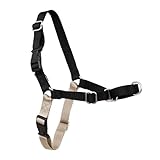
A flat collar or harness: For puppies under 6 months, a well-fitted harness is gentler on developing necks and tracheas. A front-clip harness is particularly effective because it redirects your puppy’s forward momentum back toward you when they pull.
Check Price on Amazon →
A 6-foot leash: Not retractable. Retractable leashes teach dogs to pull (they’re literally designed to extend when pulled) and give you almost no control in dicey situations. A standard 6-foot leash gives your puppy room to move while keeping them close enough to redirect.
Check Price on Amazon →
High-value treats: Bring treats on every walk for the first several months. You’re competing with squirrels, other dogs, and fascinating smells. Your treats need to be more interesting than those distractions.
Phase 1: Indoor Leash Introduction (Days 1-3)
Before you ever step outside, your puppy needs to be comfortable wearing a collar/harness and having a leash attached.
- Day 1: Let your puppy wear the collar or harness around the house for short periods (15-30 minutes). Distract them with play and treats if they paw at it.
- Day 2: Attach the leash and let them drag it around supervised (never leave a puppy alone with a trailing leash—it can catch on furniture). Feed treats while the leash is on.
- Day 3: Pick up the leash and follow your puppy around the house. Don’t try to direct them yet—just hold the leash with no tension and follow where they go. Occasionally call them to you and reward when they come.
Phase 2: The “Be a Tree” Method (Weeks 1-2)
This is the core technique for teaching loose-leash walking, and it’s deceptively simple.
The rule: When the leash is tight, you stop. When the leash is loose, you walk.
- Start walking with your puppy on leash in a low-distraction area (backyard or quiet street).
- The moment the leash goes taut, stop completely. Don’t yank, don’t say anything, just stop.
- Wait. Your puppy will eventually turn to look at you, take a step back, or create slack in the leash.
- The instant there’s slack in the leash, say “Yes!” and start walking again. If they come back to your side, give a treat.
- Repeat every single time the leash goes tight. No exceptions.
Why this works: Your puppy learns that pulling makes the walk stop (which they don’t want) and loose leash makes the walk continue (which they do want). You’re not punishing pulling—you’re making it unproductive.
The hard part: Your first few “walks” will cover about 50 feet in 20 minutes. You’ll stop dozens of times. This is normal and necessary. Most owners give up here because it feels unproductive. But each stop is a lesson. After 3-5 days of consistent practice, most puppies dramatically reduce pulling.
Phase 3: Adding Direction Changes (Weeks 2-3)
Once your puppy understands that a loose leash keeps the walk going, add unpredictability.
- Change direction randomly—make U-turns, turn corners, stop and start.
- Before each direction change, say your puppy’s name or make a kissy sound to get their attention.
- Reward them every time they follow your direction change and catch up to your side.
- This teaches them to watch you for cues instead of forging ahead on autopilot.
You can also practice “check-ins”—any time your puppy voluntarily looks up at you during a walk (without being prompted), immediately say “Yes!” and treat. This reinforces the habit of paying attention to you, which is the real foundation of good leash manners.
Phase 4: Real-World Walks (Weeks 3+)
Gradually increase the difficulty of your walks:
- Start on quiet residential streets
- Progress to busier sidewalks
- Add environments with other dogs, people, bikes
- Practice near parks, pet stores, and outdoor dining areas
Each new environment resets the difficulty. Expect more pulling in exciting new places and be patient. Bring extra treats and go back to the “be a tree” basics when needed.
Handling Specific Challenges
Lunging at other dogs: Before your puppy reaches their threshold (the distance at which they start fixating), redirect with treats and move to a comfortable distance. Ask for a sit, reward, then let them watch the other dog from a calm state. Gradually decrease the distance over multiple sessions.
Stopping to sniff everything: Sniffing is natural and important for dogs—it’s their primary way of understanding their environment. Allow designated sniff breaks (say “go sniff” and give them 30 seconds), then use “let’s go” to resume walking. This gives them the outlet they need while keeping you in control of when it happens.
Refusing to walk: Puppies sometimes plant their feet and refuse to move, especially in new environments. Don’t drag them. Instead, take a few steps away, crouch down, and call them enthusiastically. Reward any movement toward you. If they’re genuinely scared of something (loud truck, unfamiliar surface), don’t force it—create distance and try again another day.
Pulling toward home: Many dogs pull worst when heading home because they’ve learned the route. Vary your walking routes regularly and practice the “be a tree” technique in both directions.
What NOT to Do
- Don’t yank or jerk the leash. Leash corrections can damage your puppy’s neck, create fear, and actually increase reactivity. They also don’t teach your puppy what to do—only what not to do (and not very effectively).
- Don’t use choke chains or prong collars on puppies. These tools cause pain to suppress behavior. They don’t teach loose-leash walking—they teach your puppy that walking with you hurts.
- Don’t let them “just this once” pull to something interesting. Every exception undermines your training. Consistency is the only thing that works.
- Don’t walk a puppy that hasn’t been exercised. A puppy with pent-up energy will pull like a freight train regardless of training. Play fetch or tug for 10 minutes before leash training sessions.
Frequently Asked Questions
What age should I start leash training my puppy?
Start indoor leash introduction the day you bring them home (usually 8 weeks). Begin outdoor leash walks after their second round of vaccinations (around 10-12 weeks), starting in low-traffic, low-dog-population areas. Before full vaccination, carry your puppy outside to experience the world—just don’t let their paws touch the ground in high-traffic dog areas.
Which side should my dog walk on?
Traditionally, the left side. But it genuinely doesn’t matter as long as you’re consistent. Pick a side and stick with it so your dog knows where “heel position” is.
How long should leash training sessions be?
For puppies under 4 months, keep formal training walks to 10-15 minutes. Puppies tire quickly and lose focus when exhausted. As they mature, gradually increase to 20-30 minute walks. Quality matters more than distance.
My puppy bites the leash during walks. How do I stop it?
Leash biting usually means your puppy is over-stimulated or frustrated. When it happens, stop walking and wait calmly. Redirect to a toy if available. Avoid playing tug with the leash—that makes the leash a toy. If it’s persistent, coat the leash section near your puppy with bitter apple spray.
Leash training is a marathon, not a sprint. The puppies that walk beautifully on leash at 6 months had owners who were patient and consistent during months 2 through 4. Start with indoor practice, graduate to quiet streets, and build up to real-world walks. Your future self—and your shoulders—will thank you.