Cavalier King Charles Spaniel Training Guide 2026
Few dogs will stare into your soul quite like a Cavalier King Charles Spaniel. That liquid-eyed gaze is charming until it's 2 AM and your Cavalier is howling at the bedroom door because you made the catastrophic mistake of sleeping without them.
I've worked with hundreds of Cavaliers over my career, and I'll say this plainly: they are not the pushover breed that some trainers dismiss them as. They're emotionally intelligent, surprisingly quick learners, and — when training goes wrong — some of the most anxious, velcro-attached dogs I've ever seen in a consultation room. The difference between a Cavalier who thrives and one who struggles almost always comes down to how their owner approached training in the first 6 to 12 months.
That's exactly what this guide is built around. Whether you just brought home a 10-week-old puppy or you're starting fresh with a 4-year-old rescue, you'll find practical, step-by-step guidance grounded in positive reinforcement — the only approach I've found that works reliably with this breed's sensitive temperament. We'll cover everything from core foundational skills to the breed-specific challenges that catch most Cavalier owners completely off guard, like separation anxiety and leash reactivity triggered by emotional over-arousal rather than aggression.
I'll also share some mistakes I made early in my career training this breed — because a few of those hard lessons will save you months of frustration.
Before we open a single treat bag or clip on a leash, though, let's start where every good training plan starts: with a clear-eyed understanding of exactly what kind of dog you're working with.
Understanding the Cavalier King Charles Spaniel Before You Train One
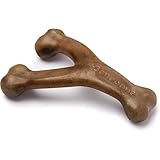
Before you teach a single sit or stay, you need to understand who you're working with. Cavaliers are not generic dogs that happen to have long ears. They're a breed shaped by centuries of very specific purpose — and that purpose will show up in your training sessions whether you account for it or not.
Cavalier King Charles Spaniels were developed as companion dogs for European royalty, bred specifically to read human emotions, stay close, and provide comfort. That heritage is a genuine training advantage in some ways: these dogs want to connect with you. But it also means they're picking up on your frustration, your impatience, your bad day at work. I've watched owners inadvertently poison an entire training session simply by showing up stressed. The dog noticed before the owner did.
Their spaniel lineage also catches people off guard. Many new Cavalier owners expect a purely decorative lap dog and are surprised when their dog freezes mid-walk, nose glued to the ground, locked onto a scent trail with laser focus. That moderate prey drive and scent curiosity is real — and it matters for leash work and recall training especially.
The Cavalier Temperament Spectrum: Why No Two Are Alike
One of the biggest mistakes I see is treating Cavaliers as a monolith. The breed has a wide temperament spectrum, and where your individual dog falls on it changes your entire approach.
Some Cavaliers are bold, bouncy, and recover quickly from startling sounds or unfamiliar situations. Others — and this is more common than people realize — are genuinely emotionally fragile. These dogs don't bounce back quickly. A sharp "no," a leash jerk, or even an owner's visible anger can cause what I call a shutdown response: the dog stops engaging, stops offering behaviors, and sometimes stops eating treats entirely for the rest of the session.
I worked with a rescue Cavalier named Biscuit in early 2026 who had clearly been through some punishment-based training before he came to me. In our first three sessions, he would sit perfectly still and look at the floor the moment I reached for the treat pouch — not because he was calm, but because he'd learned that human attention meant something bad was coming. It took six weeks of purely positive, pressure-free work before he started offering eye contact voluntarily. Six weeks, just to undo the damage.
This is not a breed that forgives harsh methods quickly. If you've trained other dogs with corrections and it "worked fine," mentally set that toolkit aside before you start with a Cavalier.
Signs your Cavalier may be on the more sensitive end of the spectrum:
- Yawning or lip-licking frequently during training
- Offering appeasement gestures (belly up, ears back) in response to mild pressure
- Shutting down rather than experimenting when confused
- Strong reaction to tone of voice changes
How Health Conditions Like SM and MVD Should Influence Your Training Plan
In 2026, Mitral Valve Disease (MVD) and Syringomyelia (SM) remain the two most significant health concerns in the breed, and both have direct implications for training that most guides completely ignore.
MVD is a progressive heart condition affecting the majority of Cavaliers by middle age. Dogs with moderate to advanced MVD fatigue more quickly and may not tolerate the physical and mental exertion of long training sessions. Five focused minutes often accomplishes more than twenty exhausting ones.
Syringomyelia — caused by a malformation at the back of the skull that puts pressure on the spinal cord — can cause chronic pain and extreme sensitivity around the head, neck, and shoulders. A dog with undiagnosed or under-managed SM may react to collar pressure, resist being touched around the ears, or seem unfocused and irritable without obvious cause. If your Cavalier seems distracted, scratches at their neck frequently, or startles at gentle touch, talk to your vet before assuming it's a training problem.
For any Cavalier with confirmed SM, I strongly recommend using a
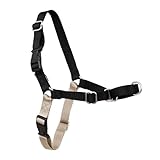
rather than a collar to eliminate any pressure near the neck entirely.
Knowing your dog's health status isn't just about veterinary care — it actively shapes how long your sessions run, what positions you ask for, and how you interpret reluctance or distraction. A dog who "won't focus" might be in pain. Rule that out first.
Setting Up for Success: Equipment, Environment, and Timing
The decisions you make about gear, location, and session length will either set your Cavalier up to thrive — or quietly sabotage everything. I've watched well-meaning owners show up to their first session with a retractable leash, a bag of large biscuits, and thirty minutes blocked out for training. We spend the first half of that time undoing those choices. Let me save you that detour.
Gear That Actually Works for Cavaliers
Collar choice matters more for Cavaliers than for many other breeds. Because Cavalier King Charles Spaniels have a genetic predisposition to Syringomyelia, pressure on the neck isn't just unpleasant — it can be genuinely painful for affected dogs. Skip choke chains and slip leads entirely. A flat martingale collar works well for ID tags and casual wear, but for any training that involves movement, get your dog into a properly fitted harness.
Two harnesses I recommend consistently are the Julius-K9 IDC and the Ruffwear Front Range
. Both distribute pressure across the chest and shoulders rather than the throat, and both are adjustable enough to fit the Cavalier’s somewhat unusual proportions — deep chest, shorter neck, feathered coat and all.
For leash length, stick to a 4–6 foot fixed leash during foundational training. The retractable leash is tempting, but it teaches your dog that pulling creates freedom — the opposite of what you want. Save the long line for recall practice later.
Session Length: Shorter Than You Think
Here's the number most owners get wrong: Cavalier puppies should train for no more than 5 minutes at a stretch, ideally across 3–4 short sessions spread throughout the day. Adults can handle 10–15 focused minutes, but even then, watch for the early signs of mental fatigue — sniffing the ground, looking away, yawning, offering random behaviors. When you see those, stop. End on a win, not on frustration.
I had a client in 2026 whose eight-month-old Cavalier was "refusing to learn." When I asked about session length, she told me she'd been doing 45-minute sessions every evening. He wasn't stubborn — he was fried. We cut sessions to 8 minutes, spread them out, and within two weeks he was flying through his basics.
The Environment Progression (Don't Skip Steps)
The most common complaint I hear is: "He knows sit perfectly at home but completely ignores me at the park." This isn't a training failure — it's an environment progression failure.
Follow this sequence deliberately:
- Stage 1: A quiet, boring room inside your home — no other pets, no TV, minimal distractions
- Stage 2: Your backyard or hallway — mild new smells, slightly more space
- Stage 3: A quiet residential street during off-peak hours
- Stage 4: A park or busier environment
Each stage is a new classroom. Your Cavalier isn't being defiant outside — he genuinely hasn't learned that "sit" means the same thing when a squirrel exists.
Building a Treat Hierarchy: Low, Medium, and High Value Rewards
Cavaliers are wonderfully food motivated, which makes training a joy — but they're also prone to weight gain, so treat discipline matters from day one.
Keep treats pea-sized and soft. Soft treats deliver faster, require less chewing, and keep the training rhythm moving. My go-to options are freeze-dried chicken (broken into tiny pieces) and Zuke's Mini Naturals

. Always deduct treat calories from your dog’s daily food allocation — a few training sessions can add up quickly.
Build a working hierarchy:
- Low value: Kibble or plain rice cakes — good for easy, well-practiced behaviors in low-distraction settings
- Medium value: Commercial soft treats like Zuke's — everyday training currency
- High value: Freeze-dried chicken, liver, or small pieces of real cheese — reserved for new behaviors, difficult distractions, or critical recall situations
Using your highest-value treats for everything devalues them. Using low-value treats in a high-distraction environment is like offering someone a handshake to run into traffic. Match the reward to the difficulty of what you're asking.
Crate and Confinement Setup for a Cavalier Puppy
Cavaliers are companion dogs to their core, which means crate training requires patience and genuine desensitization — not just "put them in and wait it out." Set up the crate
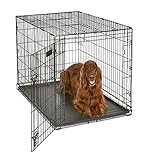
in a room where the family spends time, not isolated in a laundry room. Line it with a soft pad, add a worn t-shirt that smells like you, and begin by feeding meals near — then inside — the open crate before you ever close the door.
The goal is a crate that feels like a den, not a punishment. That distinction shapes everything that comes next.
Foundational Training: The Core Skills Every Cavalier Needs
Before we get into the fun stuff — tricks, agility, therapy work — your Cavalier needs a solid foundation. Not "he kind of does it when I have a chicken treat in my hand," but genuinely reliable performance. These five behaviors are non-negotiable: sit, down, stay, come, and leave it. I teach them in exactly that order, because each one scaffolds onto the next. You can't build a reliable stay without a solid sit. You can't build a reliable come without first teaching your dog that orienting to you is the most rewarding thing in their world.
Before you even start on "sit," though, spend the first week on something most guides skip entirely.
The Name Game: Your Most Valuable 10 Minutes in Week One
Say your Cavalier's name once, in a neutral, cheerful tone. The moment they flick their eyes toward you — not sit, not come, just look — mark it with a "yes!" and deliver a treat. Repeat 15–20 times per session, two or three sessions daily. Within a week, your dog's name should function like a magnet: wherever they are, whatever they're sniffing, the sound of their name pulls their attention to your face.
This is the foundation beneath the foundation. A Cavalier who reliably orients to their name is a Cavalier you can actually train.
Teaching Sit and Down: Step-by-Step with Timing Cues
For sit, hold a
piece just above your dog’s nose and slowly move it back over their head. Most Cavaliers drop into a sit almost immediately — their physiology makes this one of the easiest lures you’ll ever use. The moment their bottom hits the floor, mark and reward.
Use a food lure for a maximum of 5 repetitions, then fade it. With my first Cavalier, Ruby, I kept luring sit for weeks because it worked so beautifully every single time. What I'd actually created was a dog who needed to see food before she'd perform. Fading the lure means going through the same hand motion — same arc over the head — but with an empty hand, then rewarding from your other hand or a
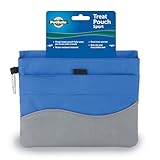
at your hip. Five reps with the lure, then switch. It feels uncomfortably fast, but your dog is smarter than you think.
For down, start from a solid sit. Bring the treat lure from your dog's nose straight down toward the floor between their front paws, then slowly out toward you. Cavaliers can be slightly resistant to down because it feels vulnerable — go slowly, reward any downward movement, and work up to the full position over several sessions.
Release cues are non-negotiable from day one. Choose "free" or "okay" and use it consistently every single time you end a position. Without a clear release word, your dog will start making their own decisions about when "stay" is finished — usually about four seconds after you ask for it.
Stay: Duration, Distance, and Distraction as Separate Variables
This is where most owners accidentally undo their own training. They ask for a sit-stay, take three steps back, wait ten seconds, and then a bicycle rolls by. Their dog breaks. They're frustrated. But they've actually asked for three skills simultaneously — duration, distance, and distraction — and these must be trained independently.
Work them in this order:
- Duration first: Ask for sit, wait one second, release and reward. Gradually extend to 5, 10, 30 seconds — with you standing right there.
- Distance second: Once your dog can hold a 30-second stay reliably, introduce one step back. Return to them to reward (don't call them to you — that collapses the distinction between stay and come).
- Distraction last: Only after duration and distance are solid. Start with mild distractions — a toy on the floor — before introducing real-world chaos.
Building a Reliable Recall — The Most Important Safety Skill
"Come" is the behavior that could genuinely save your Cavalier's life one day. Treat it accordingly. Never use "come" when you're about to do something your dog won't enjoy — like a bath or nail trim. Every single recall should end in a celebration. Use a happy, slightly ridiculous voice. Get low. Make yourself the most exciting thing in the environment.
Practice recall daily with a long line in the yard before trusting it off-leash anywhere. Proof it at a range of distances and when they're distracted by a squirrel. A recall that only works in the kitchen is not a recall — it's a suggestion.
Cavalier-Specific Challenges: Separation Anxiety, Velcro Behavior, and Emotional Sensitivity
If there's one area where Cavalier owners struggle most — and feel most guilty about — it's alone time. In 2026, Cavaliers consistently rank in my top 5 breeds for separation anxiety presentations, and I want to say this clearly upfront: if your Cavalier falls apart when you leave, that is not a training failure on your part. It's a breed predisposition baked into their DNA. These dogs were literally developed to be human companions. Expecting them to breeze through alone time without deliberate work is like expecting a Border Collie not to herd.
The good news is this challenge is absolutely workable — but only if you approach it correctly.
Velcro Behavior vs. True Separation Anxiety: Know the Difference
These two things look similar but require completely different responses, and I see them confused constantly.
A velcro dog follows you from room to room, wants to be touching you at all times, and protests a little when you leave — but ultimately settles. No destruction, no frantic pacing, no physical distress signs.
A dog with true separation anxiety shows measurable physiological stress within minutes — sometimes seconds — of your departure:
- Drooling or excessive panting at the door
- Frantic vocalization that doesn't stop
- Destructive behavior (often targeted at exit points)
- House soiling despite being fully housebroken
- Refusal to eat, even high-value food left behind
I had a client in 2026 with a 2-year-old Cavalier who was destroying door frames within 4 minutes of her leaving for work. She'd been told by a well-meaning neighbor to "just let him work it out." Six weeks later, he had lost weight and developed a hot spot from stress licking. That's not a dog working it out — that's a dog in crisis.
Never use flooding (leaving a panicking dog alone and waiting for them to habituate). It doesn't work for separation anxiety, and it can make the condition significantly worse.
A 4-Week Alone Time Desensitization Protocol
The gold standard here is the Malena DeMartini independence training protocol, which works through graduated departures — absences so short they stay below the dog's anxiety threshold, then building duration incrementally.
Here's a simplified 4-week framework:
Week 1: Departures of 3–10 seconds. Pick up your keys, step outside, come right back. Repeat 10–15 times daily. The goal is zero stress response.
Week 2: Extend to 30 seconds to 2 minutes. Vary your departure cues — don't always grab the same bag or put shoes on first. Randomizing the routine prevents it from triggering anticipatory anxiety.
Week 3: Push to 5–15 minutes, but only if Week 2 was smooth. If you see any stress signs, step back a level. Use a

or a
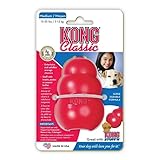
stuffed with **Xylitol-free peanut butter** (check every label — Xylitol is toxic to dogs) to create a positive pre-departure association.
Week 4: Work toward 30–45 minutes with the dog settled. Video monitoring is essential here — what looks calm from the outside sometimes isn't. Review footage from the first 10 minutes of your absence rather than relying on a